
A reborn doll reaching your shelf has already passed through weeks of hand painting, hair rooting and weight balancing — which means the buying decisions behind it look nothing like ordering a case of plush toys.
This guide walks through assortment planning, wholesale sourcing, display and compliance for retailers adding reborn baby dolls to a physical store or an online catalogue.
Do Toy Stores Actually Sell Reborn Dolls?
Yes. Reborn dolls sell through specialty toy shops, doll boutiques and gift retailers, but almost never through mass-market chains — the category sits in independent and mid-sized retail because it needs explanation at the point of sale. Buyers here are adults: collectors, hobbyists, and people seeking a comfort object.
That single fact shapes everything downstream. A store that displays reborns as collectibles, with price tiers, a short written explanation of the craft and staff who can answer questions, tends to turn stock steadily. A store that stacks them next to play dolls and waits for walk-by purchase tends to end up with the same three faces on the shelf a year later.
The difference is not traffic. It is whether the shop treats the line as a considered purchase or an impulse one — and whether the opening order was sized to test demand before committing to a full range.
What Makes a Reborn Doll Different From a Play Doll?
A reborn doll is built to be looked at and held by an adult, not played with by a child. Three things set it apart: hand-applied paint layered to simulate newborn skin tones, hair that is rooted strand by strand rather than moulded or glued, and internal weighting that gives the body a realistic, floppy heft.
Those three features drive cost, handling requirements and the way the product must be displayed. They also explain the price gap between a reborn and a doll sitting a few metres away in the same aisle — a gap customers will ask about, and one your staff need a plain answer to.
Which Reborn Doll Types Fit a Retail Shelf?
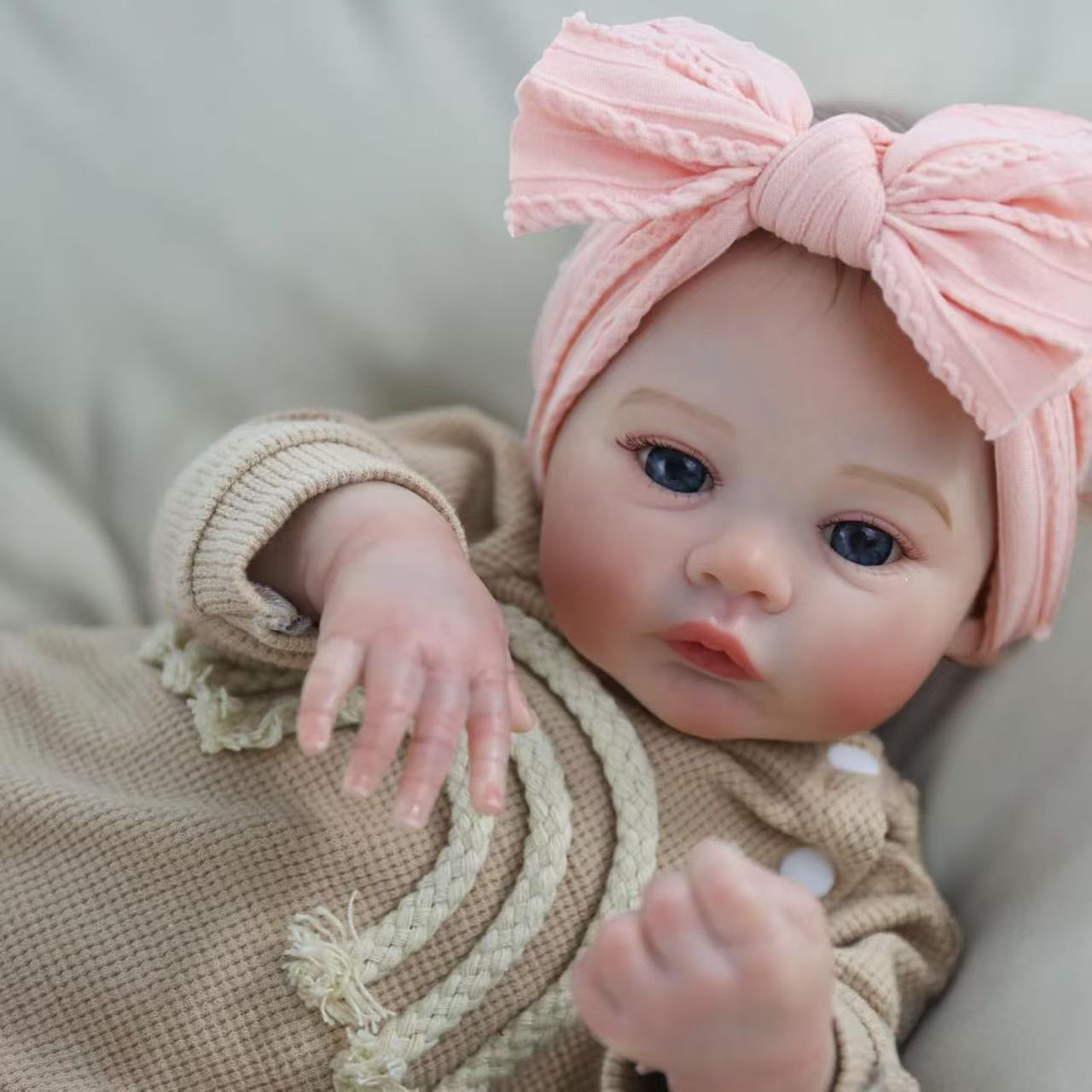
Four construction types dominate retail assortments: painted vinyl with a cloth body, partial silicone, full silicone, and toddler-sized pieces. Each carries a different price tier and handling burden, and only some suit a hands-on storefront.
Painted Vinyl With a Cloth Body
This is the volume tier. The vinyl head and limbs are painted by hand, while a soft cloth body holds the weighting and gives the doll its floppy, held-baby feel. Lower unit cost, lighter shipping, and simple bag-and-box packaging make this format the sensible entry point for a toy shop testing the category. Expect the widest selection of face sculpts here.
Partial Silicone
Partial silicone means a silicone head and limbs on a cloth body. It sits one step up: the skin reads softer and more convincing, but colour and finish vary more between units, so sample approval carries real weight. Good for a store that wants a tactile demonstration piece without committing to full silicone pricing.
Full Silicone
Full silicone dolls are moulded in one piece, weighted throughout, and typically hand-finished in small runs. They justify the highest price band and demand the most care: silicone attracts lint and dust, can mark from dark fabrics, and should not sit in direct sun or under hot display lighting. Most stores show one or two behind glass rather than on an open shelf.
Toddler and Larger Sizes
Larger toddler-size dolls appeal to a different buyer — often someone furnishing a display rather than seeking a newborn look. They photograph well online, cost more to ship due to size and weight, and consume shelf space quickly. In a physical store, one anchors a display; online, they work as a range extender.
Matching Type to Channel
- Physical storefront:painted vinyl for volume, partial silicone for a touchable hero piece, silicone behind glass.
- Online listings:full silicone and toddler sizes, where weight and packaging costs are easier to quote than to absorb.
- Mixed assortment:a small example — six vinyl dolls, two partial silicone, one full silicone display piece — lets you test price elasticity without over-committing to one construction.
How Much Do Reborn Dolls Cost at Wholesale?
Wholesale cost for a reborn doll is driven by hours of hand work, not by raw material. Two dolls pulled from the same mould can differ several-fold in price because one has painted hair and the other has individually rooted strands — so a per-unit quote means little until the specification behind it is fixed.
Materials are the smaller share of the bill. Vinyl or silicone compound, cloth bodies, glass or poly pellets for weighting, eyes, lashes and a layette set are all commodity inputs with fairly stable costs. Labour is where the money goes: multi-layer airbrush painting with heat setting between coats, strand-by-strand hair rooting (the slowest step by far), assembly, weighting and final detailing. Rooting a full head of hair can take many times longer than painting the same head, which is why hair method is the single biggest price lever in any quote.
What Moves the Quote
- Hair method:painted hair sits at the entry level; rooted hair, and especially mono-rooting, pushes unit cost up sharply.
- Body and finish:full silicone bodies cost more than vinyl with a cloth body; added details such as mottling, veining and glossed lips add labour time.
- Order quantity:larger runs spread fixed setup across more units, but hand work limits how far unit cost falls.
- Packaging:a plain poly bag and a retail-ready box with inserts and a layette are different products at different prices.
- Shipping terms:FOB quotes the goods loaded at the origin port, with freight, insurance and duty on your side; delivered pricing folds those in and hides less, but compare offers on the same Incoterm.
Ask every supplier to quote against a written specification and a stated Incoterm. A low number without both is not a lower cost — it is a different doll.
How Do You Choose a Reliable Reborn Doll Supplier?
Start with what the supplier can prove, not with what the catalogue shows. A credible maker will send a sample, explain the hair method in specific terms, and name the paint system used on the face. A trader reselling someone else’s stock will usually answer all three questions vaguely.
Ask for a photograph of the workshop floor and a list of the sculpts they own or licence. Then ask which step of production happens in-house — painting and rooting often do, while silicone casting may not. That answer tells you where a quality problem would surface.
Signals worth checking
- Sample consistency:order two samples of the same sculpt and compare; hand work should vary slightly, not wildly.
- Rooting method:look closely at the hairline — a rooted head shows individual holes in a directional pattern.
- Specification literacy:a supplier who sends a written spec unprompted will usually hold that spec on reorder.
- Reference buyers:ask for two retailers already stocking the line in your market or one with comparable regulations.
- Response time and clarity:slow, evasive answers during sampling rarely improve once money is committed.
Shortlist two or three at most. Comparing more than that against samples becomes noise, and the margin in this category does not reward endless search.
Private Label or Stock Designs: Which Route Should You Take?
Private label buys differentiation and margin control; stock designs buy speed and low commitment. For a toy store adding reborn baby dolls, the deciding factors are shelf space, price band and how often you expect the same customer to return — not the unit price gap between the two options.
Stock designs are existing sculpts and finishes a maker already produces, sold to multiple buyers under that maker’s or a neutral label. Private label means the dolls carry your store’s brand, with your chosen sculpt, paint scheme, hair colour, outfit and packaging artwork. In practice, most retailers start with stock and convert their best-selling face to private label once demand is proven.
Deciding criteria
- Shelf space:A small display unit — a few feet of glass or a lit cabinet — supports stock designs. Private label pays off when you can commit several facings to a single branded range.
- Price band:Exclusive branding usually justifies a higher retail price, but only if your packaging and presentation carry it. A mid-market shelf rarely rewards a logo alone.
- Repeat purchase:Collectors return for new sculpts, not the same one. If your customers buy once, stock designs absorb that turnover with less risk; if they collect, a branded line gives them a reason to come back to you specifically.
- MOQ and lead time:Private label raises minimum order quantities and adds artwork approval rounds before production, which pushes the first delivery further out.
- Margin control:Owning the brand limits direct price comparison with another shop stocking the same sculpt — a real advantage in a category where buyers can search a face online.
Test the water with stock designs, track which sculpts sell, then move that proven face to private label rather than committing to an unvalidated design.

What Should a Wholesale Buying Guide Cover Before You Place an Order?
A reborn doll wholesale buying guide should cover eight items before you commit: minimum order quantity (MOQ), sample approval, a written specification sheet, packaging and labelling, lead time, payment terms, inspection points, and the defect and return policy. Two of those eight decide most disputes: sample approval and inspection points. Everything else can usually be negotiated after a problem appears; those two cannot, because by the time a container lands, the sample you approved is the only document that settles what the goods were supposed to look like.
Put the approved sample in a sealed bag, label it with the date, the order number and the exact specification, and keep it until the reorder ships. When a second delivery arrives with a lighter brow or a shorter hairline, that bag is the argument. Suppliers who know you keep one tend to keep the standard themselves.
How Should a Store Display and Store Reborn Dolls?
Treat the shelf as part of the product. A reborn doll is bought on close inspection, so the display has to invite looking without inviting handling damage — and the two failure modes are opposite. Behind locked glass, the doll reads as untouchable and the craft goes unnoticed; on an open shelf beside play dolls, it collects dust, fingerprints and paint rub within a month.
The workable middle is a low glass counter case, or an open shelf with a clear “please ask to hold” sign and a staff member within sight. Holding is the sale in this category. Very few customers commit four figures to something they were never allowed to pick up.
Practical display rules
- Light:use LED, kept cool. Halogen and incandescent spots dry and discolour vinyl over months and soften silicone; direct sun does the same faster and can yellow a pale face.
- Support the head:a floppy weighted neck will slump. Sit the doll with the head against a small cushion or a purpose-made stand rather than letting it hang forward.
- Barrier against dye:silicone picks up colour from dark or unwashed fabric. Line shelves with white or undyed material and avoid black felt, printed cardboard and coloured tissue in direct contact.
- Dust:silicone is tacky and lint clings. A closed case, or a light cotton cover overnight, saves hours of cleaning and prevents the surface from dulling.
- Rotation:move the hero piece every few weeks and dress it differently. Collectors read a static display as dead stock.
- Signage:one small card per doll with sculpt name, size, hair method, edition and price — plus one longer card explaining what a reborn is. The second card sells more than the first.
Keep the original packaging, COA (if the maker issues one) and layette with each unit, and store them together in the stockroom. A doll sold without its certificate loses resale value, and collectors know it.
What Compliance and Labelling Rules Apply?
Compliance is where new entrants in this category get caught, because a reborn occupies an awkward position: it looks like a child’s toy, is built like a collectible, and is often bought by an adult. The paperwork has to be consistent with how you actually market it.
If you present and sell the doll as a toy for children, toy safety legislation applies in full — EN 71 in the EU and UK, ASTM F963 and CPSIA in the United States — including mechanical testing, flammability, phthalate limits and heavy-metal limits on paints and surface coatings. If you present it as an adult collectible, age-grade it accordingly (14+ is the common convention) and make that positioning explicit in the listing, the shelf signage and the packaging. Do not rely on a 14+ sticker alone while the website copy calls it a gift for a six-year-old; the marketing is evidence.
Documents to hold per SKU
- Test reports from a recognised laboratory, current and matching the actual production materials — not a report for a similar doll from another factory.
- Declaration of conformity where the CE or UKCA mark is claimed, naming the responsible economic operator in your market.
- Tracking label with manufacturer or importer details and a batch reference, as required for children’s products in the US market.
- Care and handling instructions in the language of the market, covering cleaning, sun and heat exposure, and small components.
- Layette compliance:clothing and blankets are textiles and usually need fibre-content and care labelling of their own, separate from the doll.
- Magnet warnings where dummies, hair bows or closures use magnets — small, strong magnets carry their own mandatory warning regime in several markets.
Weighting materials deserve a specific question: ask whether the pellets are glass, steel or synthetic, whether the bags are double-sealed, and what happens if a seam fails. “Weighted with beads” is not a specification.
Confirm the tariff classification with your customs broker before the first shipment. Classification of dolls and collectibles varies across jurisdictions, and an incorrect declaration can lead to delays, additional costs or penalties.
What Should Retailers Do Before Placing Their First Reborn Doll Order?
Before placing a first order, retailers should confirm five things: the target retail price, the product specifications, the supplier’s minimum order quantity, the approved sample and the estimated landed cost. These decisions help reduce purchasing risk and make it easier to compare suppliers on a like-for-like basis.
Start with a focused assortment rather than a large collection of similar dolls. A few carefully selected vinyl reborn dolls can help establish customer interest, while one or two silicone models can introduce a higher-priced option. The right mix depends on your customers, available display space and budget.
Before confirming production, make sure the supplier has documented the materials, dimensions, hair method, paint finish, accessories and packaging. Agree on the acceptable range of handmade variation, the inspection process and the procedure for reporting defects. For customised or private-label projects, confirm design ownership, approval stages and any exclusivity terms in writing.
Finally, calculate the landed cost rather than relying on the quoted unit price alone. Freight, duties, packaging, inspection and other applicable expenses all affect the margin you can realistically achieve.
Final Thoughts on Buying Reborn Dolls for Retail
Reborn dolls can add a distinctive, premium category to a toy shop, doll boutique or online store, but success depends on more than choosing realistic-looking products. Retailers need to understand the differences between materials and finishes, evaluate supplier capabilities, protect handmade details during storage and display, and verify the requirements of each sales market.
For a first purchase, the safest approach is to start with existing designs, inspect samples carefully and test demand with a manageable assortment. Once sales data identifies the styles and price points that resonate with your customers, you can expand the range or explore OEM and private-label development.
The key is to make each buying decision based on verified product quality, clear specifications and realistic landed costs. With a disciplined sourcing process, retailers can build a reborn doll collection that fits their customers, budget and long-term business goals.

Owen es el fundador de segunda generación de Sueban Group, un fabricante de muñecas reborn con sede en Guangdong, China. Con más de 20 años de herencia familiar en manufactura, Owen lidera las operaciones B2B de la empresa, atendiendo a mayoristas, marcas y compradores institucionales en más de 20 países.
Conoce a Owen
 English
 Deutsch
 Français
 Español
 Italiano
 Nederlands