
A reliable reborn doll supplier gives you three things a photo catalog never can: consistent material grade across every batch, a sample that matches what ships in bulk, and paperwork that clears customs in your destination market. If a vendor cannot demonstrate all three, walk away — no matter how good the price looks.
This guide is written for retailers, resellers, dropshippers, and studio owners sourcing reborn dolls at wholesale or custom volumes. It covers how to vet a manufacturer, what pricing structures actually mean, the compliance documents you genuinely need, and the red flags that separate a factory from a middleman quoting factory prices.
The Short Answer: What Separates a Reliable Reborn Doll Supplier
Before the deep dive, here is the 30-second version. A supplier worth ordering from clears six non-negotiables:
- Material grade you can name.They tell you the vinyl type or silicone platinum grade, the mohair source, and the paint system (heat-set Genesis-style paints vs. cheaper air-dry).
- Sample-to-bulk consistency.They will produce a golden sample and agree in writing that production units must match it.
- MOQ transparency.Minimum order quantities and per-tier pricing are stated up front, not negotiated into fog.
- Verifiable reviews and references.Real buyers you can contact, not three glowing anonymous testimonials on a landing page.
- Compliance documentation.EN 71, ASTM F963, or CPSIA test reports on request, matched to your market.
- Communication speed.Replies within one business day, and someone who answers technical questions instead of deflecting.
Decision framework: if you sell volume, prioritize consistency and MOQ terms. If you sell premium or custom reborn dolls, prioritize the artist’s finish quality and IP terms over price. Score any candidate against those six points; two or more misses means keep looking.
Why Supplier Choice Makes or Breaks a Reborn Doll Business
Reborn dolls are an emotional purchase. A collector paying $200 for a lifelike newborn — or a grieving parent buying one for comfort — will not forgive a lazy eye, a rooting bald spot, or paint that scratches off. Every defect converts directly into a refund, a chargeback, or a one-star review that suppresses future sales.
Do the math on a mid-size store. If your defect rate creeps from 3% to 12% because a supplier cut corners on a batch, and each return costs you the product, return shipping, and the lost customer, you can erase the margin on 40–50 clean units to absorb the damage from a handful of bad ones. Shipping delays hurt just as quietly: a custom order that slips from 45 to 90 days often arrives after the buyer’s emotional occasion has passed, triggering cancellations you cannot resell at full price.
The category itself has grown steadily. The global reborn and lifelike collectible doll segment is commonly estimated in the low-hundreds of millions of USD annually, expanding at a mid-single-digit to low-double-digit growth rate as the therapy-comfort and adult-collector markets widen. That growth pulled in a wave of new sellers — and a wider spread of supplier quality. Premium custom demand rose faster than skilled artist capacity, so the gap between a genuine studio and a rebranded factory doll has never been larger.
Wholesale vs. Custom Reborn Dolls: Two Different Supplier Profiles
Ready-stock reborn baby dolls and commissioned custom reborn dolls come from fundamentally different operations. Stock vinyl dolls are made in batches from established sculpts — fast, repeatable, and priced for volume. Custom work is slow, artist-driven, and priced by detailing hours.
Your sales model decides which “reliable” you need. A dropshipper needs stock availability, fast dispatch, and clean packaging photos. A boutique studio owner needs an artist whose micro-rooting and skin layering survive a discerning collector’s inspection. A retailer scaling volume sits in between and usually needs a direct manufacturer with a stable catalog and honest MOQ tiers.
Key Criteria for Evaluating a Reborn Doll Manufacturer
Material and Craftsmanship Standards
The base material sets the ceiling for everything else. Reborn dolls made from vinyl are the workhorse: durable, lighter, cheaper, and easy to root and paint. Full-body silicone (platinum-cure) is heavier, poseable, water-safe, and dramatically more lifelike to the touch — and it can cost five to ten times more per unit. Buyers in the therapy-comfort segment often pay for silicone specifically because of the realistic weight and squeeze.
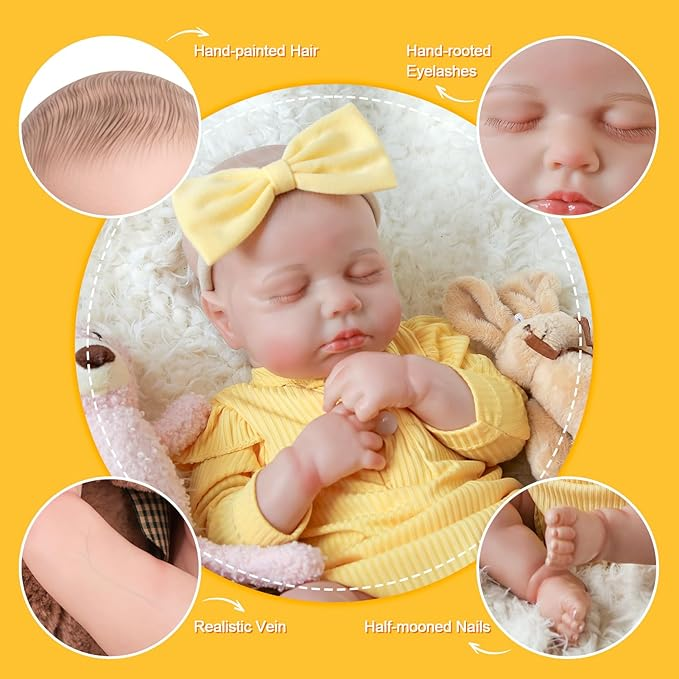
Look at how hair is applied. Micro-rooting — individual mohair strands rooted at natural density and angle, then sealed from inside — is the mark of quality work. Glued mohair or coarse rooting looks wrong under any real light and sheds. Ask about the paint system too: genuine reborn work uses heat-set paints (Genesis-style) cured in layers, which resist scratching and give translucent, buildable skin tone. Air-dry paint is faster and cheaper but far less durable.
When you inspect a sample, hunt for the realism markers that cheap production skips: subtle 3D veining under the skin, capillary mottling on the cheeks and knuckles, hand-applied nail beds, and proper weighting so the doll sits like a real infant. Weighting material should be sealed glass beads or poly-pellets distributed to mimic a newborn’s floppy weight, not a single sandbag in the torso.

Manufacturing Capacity and MOQ
MOQs vary enormously by supplier type. A direct vinyl manufacturer commonly asks for 20–50 units per style; a wholesale trading company may accept 10–30; a custom artist studio might take a single commission. Ask what the MOQ buys you — is it per SKU, per color, or per total order? That distinction changes your catalog planning entirely.
Confirm real capacity, not aspirational capacity. A studio that produces 40 quality dolls a month cannot honestly promise 300 in three weeks. Overpromising on capacity is one of the most common causes of the quality collapse you see between sample and bulk.
Quality Control and Consistency
One flawless reborn doll sample proves the supplier can make a good doll, not that they will — every time, at scale. Insist on a signed golden sample as the production reference, and ask how they inspect. Serious suppliers do in-line checks on rooting density, paint curing, and eye placement, plus a final AQL-style inspection before packing.
Get defect benchmarks in writing. A reasonable target for established vinyl production is a functional defect rate under roughly 3–5%, with a clear remedy — replacement or credit — for anything above the agreed threshold. Vague “we guarantee quality” language with no number and no remedy is worthless.
Compliance, Safety, and Documentation
Even “collectible” or “not for children under 3” dolls need documentation to cross borders cleanly. Match the paperwork to your market:
- European Union:EN 71 (parts 1, 2, and 3 covering mechanical, flammability, and migration of certain elements), plus CE marking where the product is treated as a toy.
- United States:ASTM F963 and CPSIA limits on lead and phthalates, with a Children’s Product Certificate if marketed toward children.
- General:materials declarations for the vinyl, paint, and adhesives.
Collectible labeling does not automatically exempt a lifelike doll from scrutiny at customs. If the product looks like a toy, expect it to be tested like one. A supplier who cannot produce a recent test report — or who offers a certificate for a different product — is a compliance liability you will inherit at the border.
Wholesale vs. Manufacturer vs. Trading Company: Who Are You Actually Buying From?
Three channels commonly present themselves as “the manufacturer,” and the price and communication trade-offs differ sharply.
A true factory controls the molds, rooting, and painting in-house. You get the lowest unit cost, direct technical answers, and the ability to customize — but usually higher MOQs and a longer relationship-building curve. A trading company or agent aggregates products from several factories: lower MOQs, mixed catalogs, faster dispatch, and easier English communication, at a markup and with less control over root-level quality. A reseller simply rebuys and reships stock — convenient for small tests, expensive at scale.
The tell is technical depth. Ask a specific process question — “What vinyl grade and what paint curing temperature do you use?” A factory answers immediately. A middleman goes quiet, forwards your question, and returns a day later with a vague reply.
Sourcing Regions and What to Expect
Volume reborn doll production is concentrated in China, where factory clusters offer the broadest catalogs and the most competitive per-unit pricing. High-end, one-of-a-kind custom reborns come disproportionately from independent artist studios in the US, UK, Australia, and across Europe, where labor and artistry command premium prices. You will also find skilled independent artists worldwide selling through their own channels.
Roughly speaking, regional factory sourcing wins on price and lead time; independent studios win on artistry, uniqueness, and the story that justifies a premium retail price. Many mature sellers run both — a factory line for accessible price points and a studio relationship for their flagship, high-margin pieces.
How to Vet a Reborn Doll Supplier Before You Commit
Ordering and Testing Samples
Never place a bulk order off catalog photos alone. Order at least two or three samples — ideally the same sculpt from your top candidates — so you compare like with like. Measure what matters: rooting density and shed under gentle brushing, paint durability under a fingernail scratch, weight distribution, eye and lash placement, seam finishing, and how closely the delivered skin tone matches the catalog image.
Photograph your samples in daylight and compare directly against the supplier’s marketing shots. A large gap between the two — warmer color, sharper detail, denser hair in the catalog — tells you exactly how much the marketing is flattering the reality.
Reading Reborn Doll Supplier Reviews the Right Way
Credible reviews live where the supplier cannot easily edit them: B2B marketplace transaction records with order histories, independent forums and collector communities, and direct references you contact yourself. Treat testimonials hosted only on the supplier’s own site as marketing, not evidence.
Watch the language. Reviews that are uniformly glowing, keyword-stuffed, generic (“great service, high quality, will buy again”), and clustered in a short time window are usually planted. Genuine reviews are specific and mixed — they praise the rooting but mention a shipping delay, or love the doll but note the box was dented. That texture is a good sign, not a bad one.
Verifying Business Legitimacy
Ask for the business license and verify the company name against it. Request two trade references and actually call or email them. Use payment methods with buyer protection — trade assurance on B2B platforms, escrow, or milestone-based terms — rather than wiring a full deposit to a personal account.
When evaluating a reborn doll manufacturer, request a live video factory tour or a real-time product walkthrough over video call. A legitimate operation will show you the rooting station, the painting area, and finished stock on camera. Reluctance to go live, or a “tour” that is obviously recycled footage, is a decisive red flag.
Comparison Table: Supplier Types at a Glance
Supplier Type | Typical MOQ | Price Range (per doll) | Lead Time | Best For |
Direct manufacturer (vinyl, stock) | 20–50 units | $18–$45 | 15–30 days | Retailers scaling volume |
Custom artist studio | 1–5 units | $120–$600+ | 30–90 days | Boutique / high-end collectors |
Wholesale trading company | 10–30 units | $25–$70 | 10–25 days | Dropshippers, mixed catalogs |
Full-body silicone specialist | 5–20 units | $150–$900+ | 45–120 days | Premium / therapy market |
Figures reflect typical 2026 market ranges; always verify with current quotes for your exact spec and volume.
Pricing, Payment, and Contract Terms
Price gaps between reborn doll suppliers are rarely arbitrary. The main cost drivers are material (platinum silicone dwarfs vinyl), labor (micro-rooting a full head of mohair can take many hours), detailing hours (layered heat-set painting, veining, nail work), and the eyes and accessories. A $22 doll and a $220 doll are not the same product graded differently — they are different products.
Structure payment to protect yourself. A common and fair arrangement is a 30% deposit with 70% before shipment, ideally held in escrow or under a platform’s trade-assurance program. For custom runs, milestone terms — deposit, payment at approved sample, balance at pre-shipment inspection — keep leverage on your side until the work is right.
Negotiating Wholesale Terms Without Sacrificing Quality
Negotiate on structure, not just headline price. When sourcing reborn dolls, ask for volume breaks at defined quantity tiers, sample credits applied against your first bulk order, and locked re-order pricing for a set period so a good SKU doesn’t creep up in cost every time you restock.
Put the protective terms in writing, not just the price. Define the defect-return policy and threshold, any restocking terms, packaging standards, and — critically for custom reborn dolls — who owns the sculpt and artwork. If you pay to develop a custom mold, specify in the contract whether that mold is exclusive to you or free for the factory to resell to your competitors.
Common Mistakes When Choosing a Reborn Doll Supplier
- Choosing on unit price alone.A $5-cheaper doll that carries higher shipping, surprise customs duties, and a 12% defect rate is the expensive option.
- Skipping samples and bulk-consistency checks.The catalog doll and the pallet you receive can be two different qualities if you never lock a golden sample.
- Overlooking compliance documents.Missing EN 71 or CPSIA paperwork can strand a shipment at customs and torch your launch timeline.
- Leaving custom IP undefined.Not clarifying ownership of custom sculpts and artwork lets a factory sell “your” exclusive design to everyone.
Building a Long-Term Supplier Relationship
The best sourcing outcomes come from repeat relationships, not one-off deals. A supplier who values your reorders will hold quality steady, give you priority production slots during peak season, and take your quality feedback into the next batch instead of arguing about it.
Still, keep a vetted backup supplier warm — even at a slightly worse price — for demand spikes and risk hedging. Single-sourcing a seasonal, emotionally driven product is how a factory fire, a customs hold, or a capacity crunch turns your Q4 into lost revenue you can’t recover.
Frequently Asked Questions
What is a good MOQ for a first reborn doll order?
For a first order testing a new supplier, keep it small enough to limit risk but large enough to judge consistency — commonly 5–10 stock units, or a single unit for a custom studio. Many trading companies will accept low first-order quantities specifically so buyers can evaluate them; use that to test bulk consistency before committing to a 50-unit run.
How can I tell if a “manufacturer” is really a middleman?
Ask a technical process question — vinyl grade, paint curing temperature, rooting method — and watch the
response time. A real factory answers instantly and in detail because the person you’re talking to works next to the production line. A middleman pauses, forwards the question, and returns a day later with a vague or copy-pasted reply. Other tells: they can’t provide their own factory license, the “factory address” doesn’t match the business registration, and they resist a live video tour. None of these alone is disqualifying, but two or three together mean you’re paying a markup for a layer of separation you didn’t want.
Do collectible reborn dolls really need safety testing?
If the doll looks like a toy, customs and marketplaces may treat it like one regardless of your “collectible” or “not for children under 3” labeling. For the EU you’ll typically want EN 71 reports, and for the US, ASTM F963 and CPSIA compliance if there’s any chance it’s marketed toward children. The safer move is to have current test reports on file before you ship, not scramble for them when a shipment gets held. Ask the supplier for reports dated within roughly the last year and matched to the exact product and materials you’re buying — not a generic certificate for a different sculpt.
How long should sample evaluation take before I commit to bulk?
Budget two to four weeks from sample arrival to decision. Use that window to stress the reborn doll the way a real customer will: brush the hair to check shedding, scratch a hidden area to test paint durability, handle the weighting, and photograph everything in daylight against the catalog images. If you’re sourcing custom work, extend the timeline and require an approved golden sample in writing before any production quantity is authorized.
What’s the single biggest predictor of a bad supplier experience?
Communication behavior during the vetting stage. A supplier who is slow, evasive, or defensive before you’ve paid anything will not improve after your deposit clears — that’s when their incentive to impress you is highest. Responsiveness, willingness to answer technical questions, and openness to a live video walkthrough predict how they’ll handle a defect dispute far better than any price quote does.
Your Supplier Vetting Checklist
Before you send a deposit, confirm you can check every box below. Treat two or more gaps as a signal to keep looking rather than a problem to fix after payment.
- Material grade named in writing — vinyl type or silicone platinum grade, mohair source, and paint system.
- Golden sample produced and signed off as the binding production reference.
- MOQ, per-tier pricing, and re-order pricing stated clearly and in writing.
- Recent, product-matched compliance reports for your destination market on file.
- Verified business license, two contactable trade references, and buyer-protected payment terms.
- A live video tour completed, showing the rooting, painting, and packing areas.
- Defect threshold and remedy — replacement or credit — defined in the contract.
- Custom IP ownership specified: who controls the sculpt and artwork you paid to develop.
Sourcing a reliable reborn doll supplier is slower and more deliberate than sourcing most product categories, and that’s the point. The dolls carry emotional weight for the people who buy them, so the cost of a bad batch lands harder than a few refunds — it lands on your reputation. Move at the pace the product deserves: sample thoroughly, verify independently, contract carefully, and build the relationship once you find a partner worth keeping.

Owen is the second-generation founder of Sueban Group, a reborn doll manufacturer based in Guangdong, China. With over 20 years of family manufacturing heritage, Owen leads the company's B2B operations serving wholesalers, brands, and institutional buyers across 20+ countries.
Meet Owen →
 English
  Deutsch
  Français
  Español
  Italiano
  Nederlands