
Wholesale reborn dolls are hand-finished or kit-assembled reborn baby dolls that mimic a real infant, sold in multi-unit lots rather than as single pieces. For shop owners, therapy suppliers, resellers, and simulation programs, sourcing from a reliable reborn doll supplier or manufacturer can make the wholesale channel the difference between a 30% retail markup and a business that actually scales.
This guide covers the material science, supplier vetting, landed-cost math, and inventory discipline that separate profitable volume buyers from people sitting on 60 unsellable dolls. Whether you are sourcing vinyl reborn dolls, silicone reborn dolls, or custom reborn dolls, understanding materials, product quality, supplier capabilities, and total landed costs can help you make better purchasing decisions.
What Are Wholesale Reborn Dolls? (And Who Actually Buys Them at Volume)
A reborn doll is a vinyl, silicone, or cloth-bodied figure finished to imitate a newborn — painted in translucent layers, weighted to feel like a real infant, and often hand-rooted with mohair. Today, reborn baby dolls are available in different materials and production styles, including vinyl reborn dolls and silicone reborn dolls. The “reborn” process started in the early 2000s as a hobbyist craft, where artists stripped and repainted mass-market doll kits. Today, the market spans two distinct supply streams: factory-produced dolls from a reborn doll manufacturer and artist-assembled kits.
Wholesale simply means buying those dolls in lots. Most reborn doll suppliers set minimum order quantities (MOQs) between 6 and 24 units, or a dollar minimum around $500–$1,500. Below that threshold, you are a retail customer paying retail prices.
Who actually buys at volume
- Brick-and-mortar gift and collectible shops— physical displays move silicone better than photos do
- Hospital simulation and training programs— nursing and obstetrics programs buy vinyl units in lots of 10–30 for skills labs
- Therapy and dementia-care providers— care facilities purchase cuddle-style dolls for sensory and anxiety-reduction programs
- Online resellers— Etsy, eBay, and Amazon sellers who never touch inventory beyond a storage unit
- Doll-show vendors— table sellers who need 20–40 pieces per event across multiple SKUs
- Photographers— newborn and prop photographers who need durable, lightweight units they can pose repeatedly
Why the channel matters now
Single-unit retail margins rarely exceed 30–40% once you account for platform fees, packaging, and returns. Bulk sourcing can push gross margins to 50–65% before shipping and customs — and that spread is what funds the photography, listing labor, and customer service this category demands.
Quick answer: Wholesale reborn dolls are factory-produced or artisan-assembled dolls purchased in lots, priced per unit well below retail, and typically restricted by MOQ, lead time, and material grade. Expect $18–$65 per unit for vinyl, $70–$280 for partial silicone, and $120–$900+ for full-body silicone.
Wholesale Reborn Dolls vs. Retail: What You’re Actually Trading Away
Bulk pricing is not free money. You give up something real at every step, and knowing what is the difference between a calculated trade and a costly surprise.
Unit cost versus curation. Wholesale removes your ability to hand-pick every face sculpt and rooting pattern. You buy what the mold lot produces. Suppliers may offer 3–6 face options within a single SKU, but you do not choose individually painted variations.
Lead times. Asian manufacturers typically run 15–45 days plus transit. Domestic US and EU distributors ship in 5–14 days but charge 10–25% more per unit. If you have a doll show in three weeks, that premium is often worth it.
Warranty asymmetry. Wholesale terms usually limit returns to defect-only claims filed within 7–14 days of receipt. Retail buyers get consumer protection statutes; wholesale buyers get a contract clause.
When retail sourcing still wins. One-off artist dolls, competition pieces, and limited editions under 20 units should be bought retail every time. These carry provenance — signed certificates, artist documentation — that wholesale lots simply cannot provide. Collector buyers pay a premium for that paper trail.
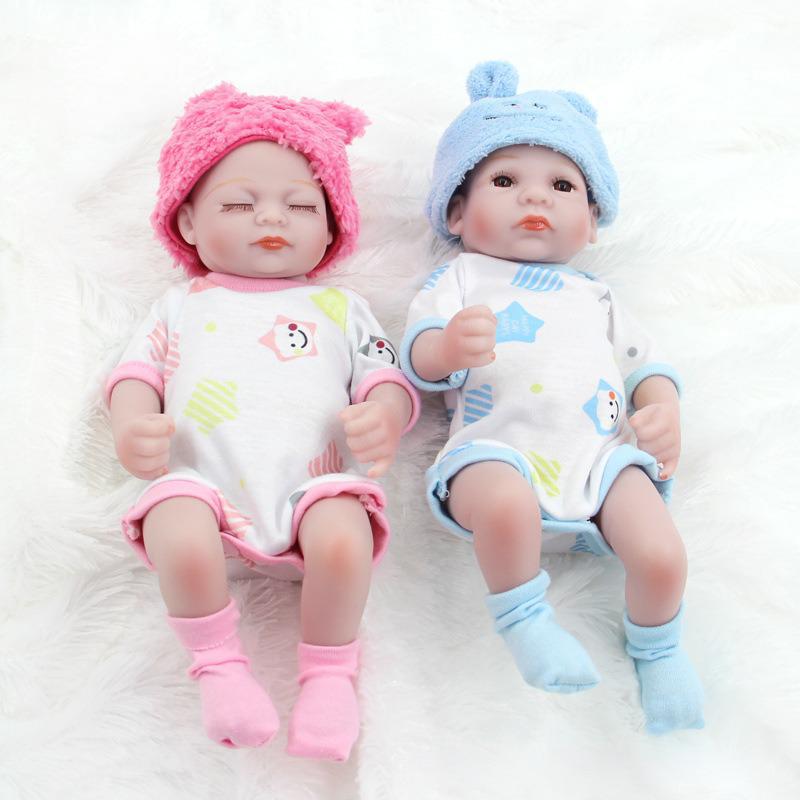
The Material Decision That Drives Everything: Vinyl vs. Silicone vs. Cloth
Material choice determines your price band, target customer, defect rate, freight cost, and compliance path before you place a single order. Get this wrong and no amount of marketing fixes it.
Vinyl Reborn Dolls (Unscented, Heat-Set, Most Common)
Construction is straightforward: vinyl is poured into steel molds for the head and limbs, then attached to a weighted cloth body. Most factory units use heat-set or air-dry acrylic paint sealed with a matte varnish.
Price band: roughly $18–$65 wholesale per unit depending on size and painted detail.
Strengths: lightweight, durable, cheapest entry point, and enormous mold variety — you can stock 15 different sculpts without inventory bloat.
Weaknesses: stiff limbs that read as rubbery to collectors, a glossy sheen that shows up badly in photographs, and paint rub on high-contact areas like noses, fingers, and toes.
Full-Body and Partial Silicone Reborn Dolls
Quality silicone reborns use platinum-cure (addition-cure) silicone — not tin-cure, which yellows and degrades. Full-body units are poured into molds, often with an internal armature for posing.
Price band: $120–$900+ wholesale per unit for full-body; partial silicone (silicone head and limbs on a cloth body) lands $70–$280.
Strengths: genuine matte skin texture, softness that photographs convincingly, premium resale value, and strong demand from therapy programs that want realistic weight and feel.
Weaknesses: high unit cost, tear risk at joints and the neck flange, dust attraction that requires matte powder maintenance, and freight that punishes you by weight.
Cloth and “Cuddle” Reborns
Construction is a weighted fabric body with a sculpted cloth or minimal vinyl head. No paint layers, no rooting to fail.
Price band: $12–$40 wholesale.
Best fit: dementia and anxiety therapy programs, sensory rooms, and low-budget resellers who need volume at a defensible price point.
One caution: collector communities frequently exclude cloth cuddle dolls from their definition of “reborn.” Label them clearly and accurately if you resell, or expect returns and reputation damage.
Material Comparison Table
Attribute | Vinyl | Partial Silicone | Full-Body Silicone | Cloth |
Wholesale unit cost | $18–$65 | $70–$280 | $120–$900+ | $12–$40 |
Realism | Moderate | High | Highest | Low |
Durability | High | Moderate | Moderate–Low | High |
Target buyer | Resellers, beginners | Collectors, therapists | Collectors, high-end resellers | Care facilities |
MOQ typical | 10–24 | 6–12 | 3–6 | 24+ |
How to Vet a Wholesale Reborn Doll Supplier
This niche attracts counterfeiters precisely because buyer sophistication varies so widely. Vetting is not paranoia; it is the core skill of the job.
Certifications to request
- CPSIA compliance documentationfor US-bound product
- EN 71-1/2/3 test reportsfor EU shipments — mechanical, flammability, and migration of certain elements
- ASTM F963if the product is marketed as a toy in the US.
Red flags that should end the conversation
- Personal payment accounts.A supplier who wants a wire to an individual’s name, or who pushes you off-platform into WhatsApp-only terms, has removed your only recourse.
- Borrowed catalog photography.Reverse-image-search three hero photos. If they trace back to an Etsy artist, the “factory” is a dropshipper.
- Prices 40%+ under the market floor.Vinyl that should run $32 is offered at $14 because the paint is two layers instead of seven, the body is sand instead of glass beads, or the doll does not exist.
- Refusal to send a video of the mold room and the packing table.Anyone with real production can walk 20 feet and film it.
- Material ambiguity.“Silicone-like,” “soft silicone blend,” and “silicone touch” almost always mean TPE — a thermoplastic elastomer that leaches oil, dulls within months, and cannot be repainted. Ask for a platinum-cure confirmation in writing and a cure-type statement on the spec sheet.
- Anatomically detailed childlike variants in the same catalog.Several jurisdictions — including the US, UK, Canada, and Australia — treat childlike sex dolls as illegal or obscene material. A single such item in a shared container can put your entire shipment under seizure and your name in an investigation. Verify a supplier’s full catalog before you pay a deposit.
The sample order is cheap insurance
Buy one to three units at near-retail before committing to a lot. You are not evaluating the doll as a customer would; you are evaluating it as an inspector. Work through this checklist and photograph everything:
- Paint depth at the extremities.Run a thumbnail lightly across a toe and a nostril wing. A properly sealed reborn holds; a cheap one chalks.
- Rooting density.Part the mohair at the crown. You should not see scalp. Sparse rooting is the single most common factory shortcut and the hardest defect for a customer to forgive.
- Weight distribution.A newborn’s mass sits low and forward. If the doll feels like a sandbag in the torso, the weighting was poured without anatomy in mind.
- Flange and seam integrity.On silicone, flex the neck opening. Thin flanges tear in transit, not in your shop — meaning the customer finds them first.
- Tin-cure silicone smells faintly of vinegar or rubber and will outgas. Platinum-cure should smell like almost nothing.
- Check that eyes are set level, that eyelashes are glued at the root and not the tip, and that the body stuffing does not shift when the doll is seated.
Landed Cost Math: The Only Number That Matters
The wholesale price on the invoice is not your cost. Landed cost is the FOB unit price plus freight, duty, brokerage, inbound quality inspection, last-mile delivery, and payment and currency fees — divided by units that are actually sellable, not units that arrived.
Most first-time buyers underprice by 30–50% because they forget three lines: the defect allowance, the freight on returned goods, and the cost of cash tied up during a 45-day production run plus 30-day sea transit.
Worked example: 24 vinyl units, air freight
Line item | Basis | Cost |
Goods (FOB) | 24 units × $32 | $768.00 |
Air freight | 55 kg chargeable × $5.50/kg | $302.50 |
Duty (illustrative 7.5%) | on declared value | $57.60 |
Customs entry & brokerage | flat per shipment | $125.00 |
Inbound QC (AQL sampling) | flat per lot | $85.00 |
Domestic last mile | flat per shipment | $95.00 |
Payment & FX fees | 2.5% of goods | $19.20 |
Total landed | ÷ 22 sellable units | $1,452.30 → $66.01/unit |
That is the number to build your retail price from — $66.01, not $32. Price at $129.99 and you are running roughly 49% gross margin before platform fees, which is a real business. Price at $79.99 because you anchored on the invoice and you are working for free.
Classify the product before you order, not after
Dolls representing human beings generally fall under heading 9502 in most tariff schedules, with chapters 9503 and 9505 sometimes applying depending on how the item is presented and marketed. Base duty rates for dolls have historically been low or free in the US and EU, but additional measures targeting Chinese-origin goods have been applied, revised, and expanded repeatedly over the past several years, and rates as of late 2026 may differ from anything printed in a 2023 guide. Do not guess. Ask your customs broker for a written classification opinion, an origin determination, and a duty estimate against your actual invoice value — then re-run the table above with their numbers before you sign a purchase order.
Air versus sea, in practice
- Air freightkills you on full-body silicone, which runs 3–5 kg per boxed unit. It makes sense for samples, restocks of a proven winner, and any order under about 30 kg.
- Sea LCLcosts a fraction per kilo but adds 25–40 days door-to-door and introduces consolidation handling, which is where damage and pilferage happen.
- Full containeronly makes sense above roughly 10–14 CBM, and only if you can absorb the working capital for a full quarter.
Negotiating MOQ Without Burning the Relationship
MOQs are rarely as fixed as the catalog claims. Suppliers hold a floor, not a wall, and there are four levers that move it.
- Mix SKUs to hit the dollar minimum.Twenty-four units across four sculpts is usually more attractive to a factory than twenty-four of one, because it lets them clear mixed mold runs.
- Trade timing for quantity.Ask what is already in production and can be added to an existing run. You give up sculpt choice; you gain two weeks and often 8–15% on price.
- Pay a larger deposit.Moving from 30% to 50% up front is real risk reduction for them and frequently buys a lower tier.
- Commit to a repeat schedule.A written intent to reorder quarterly is worth more than a one-time order, and good suppliers will price it that way.
How to Choose a Wholesale Reborn Doll Supplier
Before working with a supplier, check:
- Material and product quality
- Size and weight
- Customization capabilities
- Production capacity and lead time
- Relevant certifications and testing
- Quality-control process
- Packaging and shipping options
- Communication and after-sales support
For larger purchases, always inspect samples first and calculate the total landed cost before confirming your quantity.
Frequently Asked Questions
What are wholesale reborn dolls?
Wholesale reborn dolls are reborn baby dolls purchased in multiple units from a supplier or manufacturer. They can be made from vinyl, silicone, or other materials.
What is the difference between vinyl and silicone reborn dolls?
Vinyl dolls are generally lighter and more affordable, while silicone dolls are softer and can provide a more realistic tactile experience.
Can reborn dolls be customized?
Many manufacturers offer customization such as skin tone, hair, clothing, packaging, and sculpting. Options vary by supplier.
How do I find a reliable reborn doll manufacturer?
Check the supplier’s product quality, materials, production capabilities, testing documents, customization options, lead times, and communication. Ordering samples before larger quantities is also recommended.
Conclusion
Wholesale reborn dolls offer opportunities for retailers, resellers, collectors, therapy providers, and custom brands. Choosing the right material and supplier is essential for controlling quality, cost, and customer satisfaction.
Whether you choose vinyl reborn dolls, silicone reborn dolls, or custom reborn dolls, compare the complete product specifications and landed costs before making a purchasing decision. A reliable reborn doll manufacturer can help you build a consistent product range and support your business as it grows.

Owen is the second-generation founder of Sueban Group, a reborn doll manufacturer based in Guangdong, China. With over 20 years of family manufacturing heritage, Owen leads the company's B2B operations serving wholesalers, brands, and institutional buyers across 20+ countries.
Meet Owen →
 English
  Deutsch
  Français
  Español
  Italiano
  Nederlands